Hawaiian Words and Meanings
The everyday vocabulary you will see on signs, menus and maps, and what each word really says.
Get Free Hawaii Trip QuotesHawaiian Words and Meanings Every Visitor Meets
You will hear Hawaiian words within minutes of landing: on airport signs, in hotel lobbies, on restaurant menus and in the way people give directions. This list of Hawaiian words and meanings sticks to the ones visitors actually encounter, with short notes on how they are used, so you know what a sign is asking and what a host is telling you.
Spellings below use the ʻokina (the reversed-apostrophe mark) and the kahakō (the line over a vowel), because they change pronunciation and sometimes meaning. If those marks are new to you, read the Hawaiian language alphabet page first. Greeting phrases such as good morning, welcome and see you later are collected on our sister site Hawaiian Greeting, so we do not repeat them here.
| Word | Meaning and how you will see it |
|---|---|
| ʻohana | Family, including extended family and close friends treated as kin. |
| keiki | Child or children; you will see “keiki menu” in restaurants. |
| kūpuna | Elders or grandparents; a term of real respect. |
| kamaʻāina | A long-time resident, literally “child of the land.” Some businesses offer kamaʻāina rates to residents with Hawaii ID. |
| malihini | Newcomer or visitor. Not an insult; everyone is malihini somewhere. |
| kōkua | Help or cooperation. “Please kōkua” on a sign means please cooperate. |
| mahalo | Thank you. You will also see it on trash bins; it is not the word for trash. |
| pau | Finished, done. “Pau hana” means after work. |
| ʻono | Delicious. |
| pūpū | Snacks or appetizers; also the word for a shell. |
| wikiwiki | Quick or fast, as in the airport shuttle at Honolulu. |
| mauka | Toward the mountains, inland. Used instead of compass directions. |
| makai | Toward the sea. |
| hale | House or building. |
| lānai | Porch, balcony or veranda (and the name of an island, said differently in context). |
| kāne / wahine | Man / woman; common on restroom doors. |
| ʻāina | Land, that which feeds; central to Hawaiian values. |
| kuleana | Responsibility and privilege at once; your share of a duty. |
| pono | Righteous, balanced, the right way to do something. |
| mana | Spiritual power or authority. |
| kapu | Forbidden or sacred. A “kapu” sign means keep out. |
| heiau | A traditional place of worship, usually built of stone. |
| aliʻi | Chief or royalty. |
| mele | Song or chant. |
| honu | Green sea turtle. |
| puka | Hole, as in a puka shell or a hole in a wall. |
| hana hou | Again; shouted at concerts to ask for an encore. |
| lūʻau | Feast; originally the name of young taro leaves cooked in a favorite dish. |
Words for Food and the Table
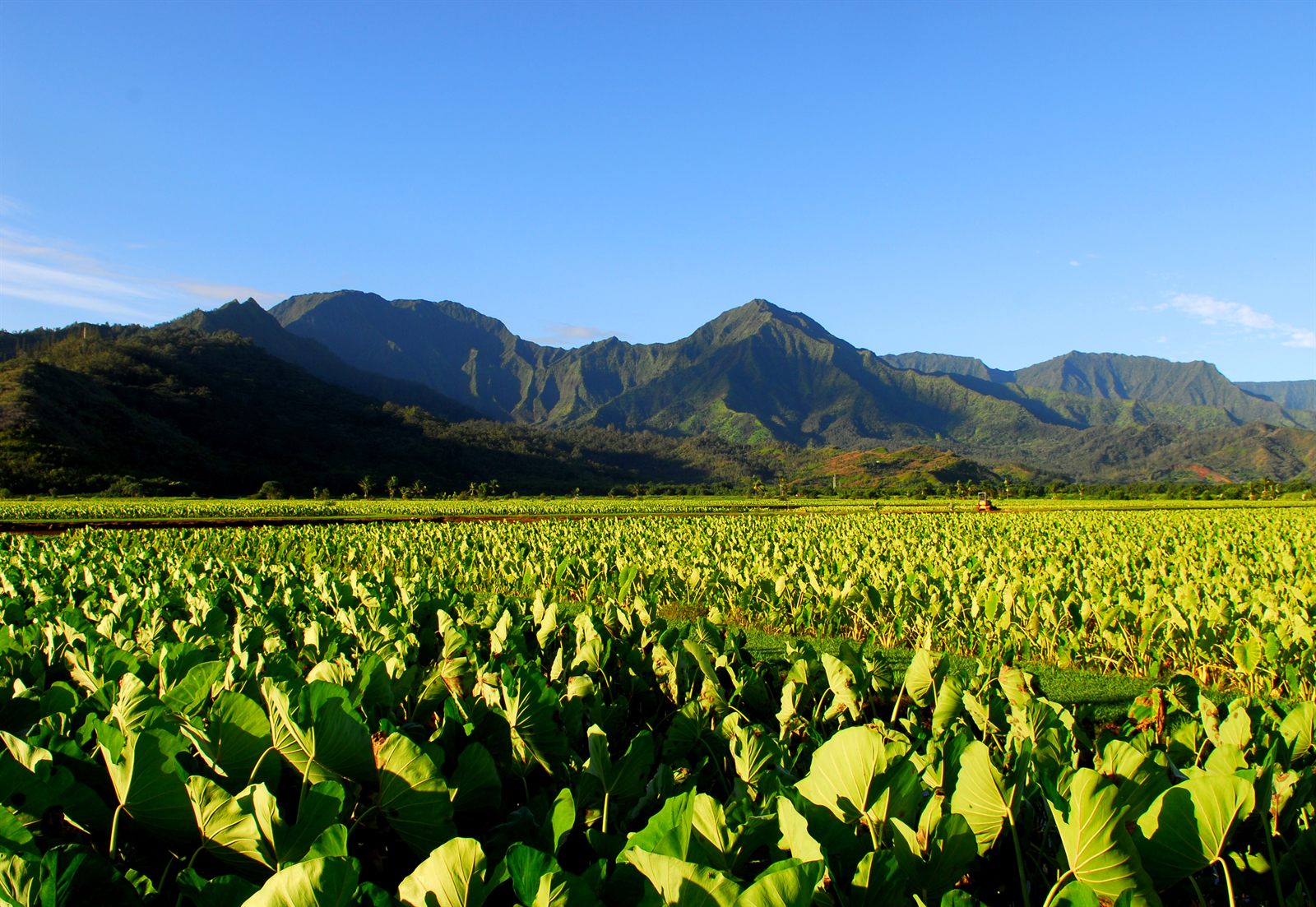
Food words are the ones visitors use most. Kalo is taro, the plant at the center of the traditional diet and, since 2007, the official state plant. Poi is cooked kalo pounded into a paste; locals often describe it as one-finger, two-finger or three-finger poi depending on how thick it is. Laulau are bundles of meat or fish wrapped in kalo and ti leaves and steamed. Kālua describes food baked in an imu, an underground oven, as in kālua pig at a lūʻau. Poke means to cut into pieces, which is why the cubed raw-fish dish carries the name.
Many island food words are not Hawaiian at all but come from the plantation era, when workers from China, Japan, Portugal, the Philippines, Korea and elsewhere shared lunch. Malasada (a Portuguese doughnut), musubi (from Japanese) and the “plate lunch” itself belong to that mixed local culture.
Words That Carry Values
A handful of Hawaiian words carry ideas that do not translate neatly into one English word, and you will meet them on signs, in speeches and in conversation. Aloha is the best known; its full meaning is covered on our aloha page. Mālama ʻāina means to care for the land, and it is the idea behind many visitor requests in parks and on beaches. Kuleana is responsibility that comes with belonging. Pono is doing things rightly and in balance; the state motto ends with the words “i ka pono.” ʻOhana stretches well beyond parents and children.
Using these words lightly or as slogans can sound hollow. Learning what they mean, and noticing when people use them seriously, is one of the best ways into Hawaiian culture.
Frequently Asked Questions
What does haole mean?
Haole is the common word for a foreigner, and in everyday use usually for a white person. It is often neutral or affectionate, but tone matters, so visitors are better off not using it about themselves or others.
How do people give directions in Hawaii?
With mauka (toward the mountains) and makai (toward the sea) rather than north and south. In Honolulu you will also hear “ʻEwa” (toward the ʻEwa district, roughly west) and “Diamond Head” (toward the crater, roughly east).
Turn Your Word List Into a Trip
Our travel specialists plan Hawaii vacations island by island. Tell us what you want to experience and get a free quote.
Get a Free Hawaii Quote